Paid the mechanic and the car still isn’t fixed?
Understand what happened before you spend more money.
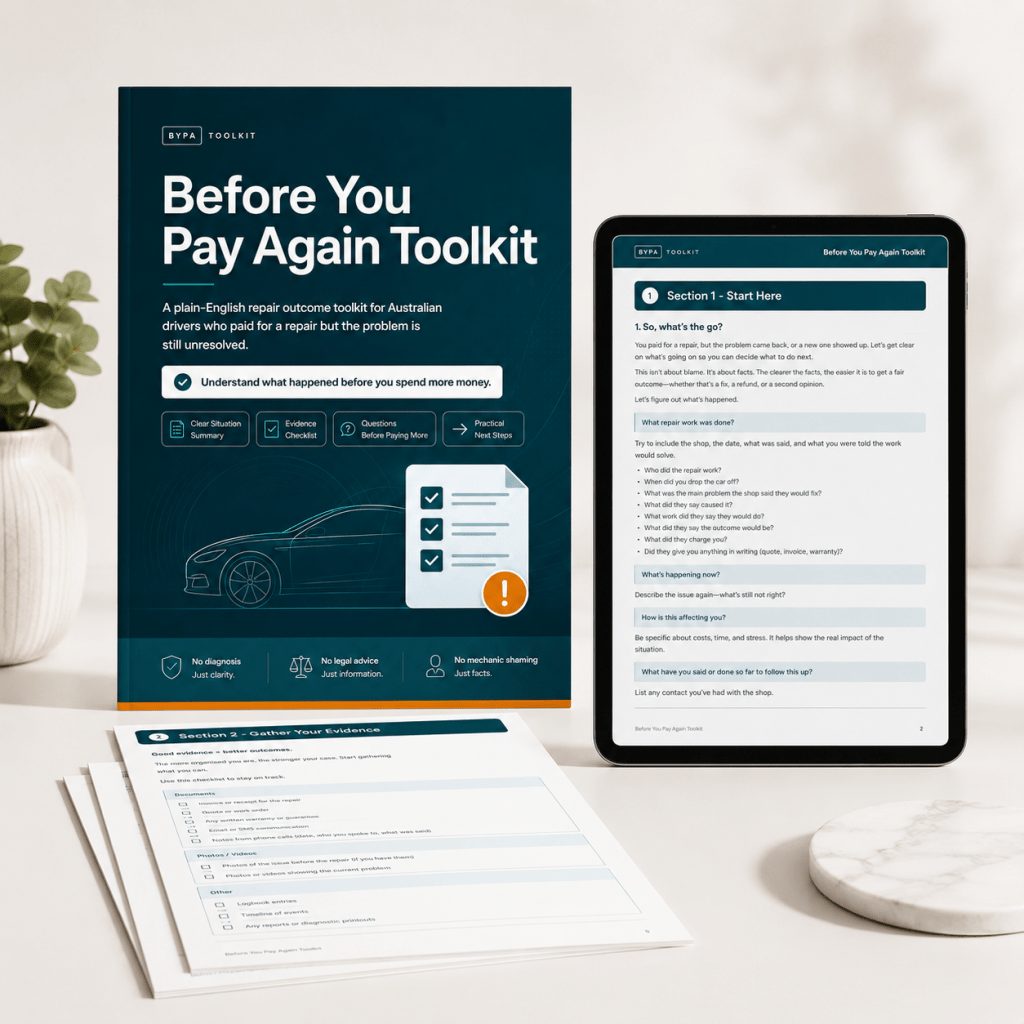
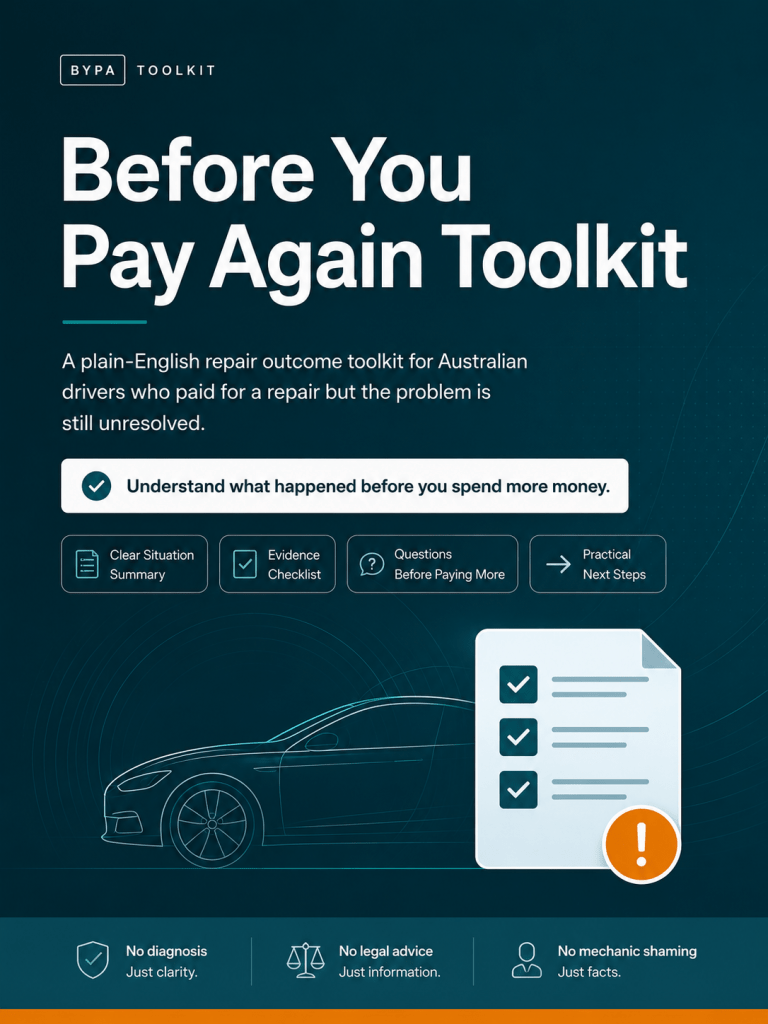
A plain-English toolkit for Australian drivers who paid for a repair but still don’t have a clear outcome.
Instant PDF download · $29 AUD · No diagnosis · No legal advice · No mechanic shaming
You paid for work. The problem is still there.
This situation can get confusing quickly.
You may not know whether the original repair failed, whether the first job was only part of the diagnostic process, whether a new issue has appeared, or whether you are being asked to approve more work without enough explanation.
Before you spend more money, you need to get clear on four things:
- What did you report?
- What did you approve?
- What did you pay for?
- What is still happening now?
The Before You Pay Again Toolkit helps you organise those facts before you decide what to do next.
What the toolkit helps you do
The toolkit gives you a simple structure to slow the situation down and work through it clearly.
It helps you:
• organise what happened
• separate what you reported from what was approved
• understand what the invoice actually says
• write down what is still unresolved
• collect useful evidence
• ask calmer, clearer questions before paying more
• prepare for a second opinion
• understand where official Australian help may start
It does not tell you what decision to make.
It helps you make the next decision with better information.
What’s inside the toolkit
You receive three PDF versions:
• Professional PDF for reading on screen
• Fillable PDF for completing digitally
• Print-friendly PDF for lower-ink printing
The toolkit includes:
• Situation Summary
• Repair Outcome Check
• What Did You Actually Pay For?
• Diagnosis Explanation Worksheet
• Evidence Checklist
• Questions Before Paying More
• Second Opinion Preparation Sheet
• Official Bodies and Next Steps
• Before You Decide Checklist
The goal is not to prove anyone wrong.
The goal is to help you understand the repair process clearly enough to decide your next step.
What this toolkit does not do
This toolkit is designed to help you organise the repair situation, not replace professional advice.
It does not:
• diagnose your vehicle
• interpret fault codes
• tell you which part has failed
• review your personal invoice or case
• provide legal advice
• guarantee a refund
• accuse any workshop
• write a tribunal claim for you
It helps you slow down, organise the facts, collect useful evidence, ask clearer questions, and decide the next practical step before paying again.
The wording is calm on purpose.
The goal is not to attack the workshop. The goal is to understand what happened.
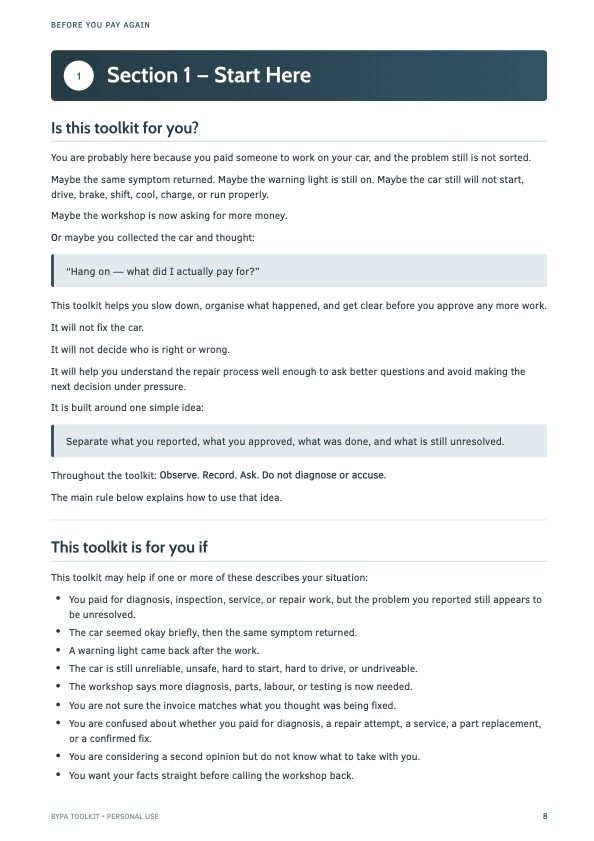
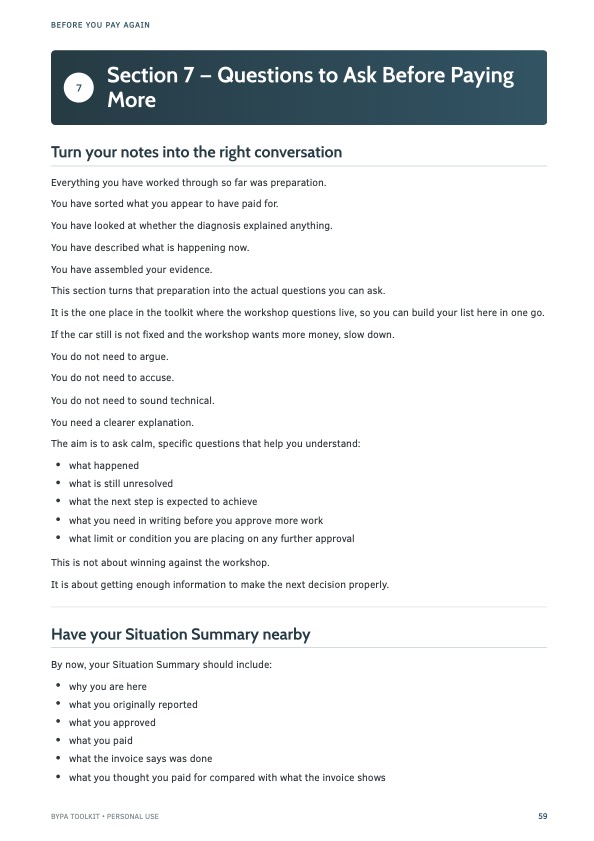
Preview the toolkit
Here are a few sample pages so you can see the style and structure before buying.
The full toolkit includes the complete worksheet process, evidence checklist, question sets, second-opinion preparation sheet, and Before You Decide checklist.
Helpful repair-outcome articles
Plain-English articles to help you slow the situation down, organise the facts, and ask better questions before approving more repair work.
- Paid the mechanic and the car still isn’t fixed — what should you check before paying again?
- Mechanic wants more money but the car still isn’t fixed — what should you ask first?
- Mechanic replaced a part but the car still has the same problem — what should you check?
- Warning light came back after a repair — what should you check before paying more?
- Mechanic says no fault found but the car still has a problem — what should you ask?
- Same problem after a car repair — is it the same fault or something else?
- Paid for car diagnosis but still don’t know what’s wrong — what should you ask?
Frequently asked questions
Is this legal advice?
No. This toolkit does not provide legal advice. It helps you organise what happened, collect evidence, ask clearer questions, and decide your next practical step.
Will this diagnose my car?
No. It does not diagnose the vehicle, interpret fault codes, or tell you which part has failed.
Can I use this before getting a second opinion?
Yes. The toolkit is designed to help you prepare your repair history, symptoms, invoice details, evidence, and questions before speaking to another mechanic, auto electrician, dealer, or inspector.
Is this anti-mechanic?
No. The toolkit is intentionally calm and factual. It does not accuse workshops or tell you to attack anyone. It helps you understand what was reported, approved, paid for, and what still needs explaining.
What do I receive?
You receive three PDF versions: a professional reading version, a fillable digital version, and a print-friendly version.
How do I receive it?
This is an instant digital download. After purchase, you receive access to download the PDF files.
Before you pay again, get clear first.
If the car still is not fixed and you are being asked to spend more money, slow the situation down before making the next decision.
Use the toolkit to organise what happened, what was approved, what was paid for, what is still unresolved, and what to ask next.
