Paid for diagnosis, but the mechanic says no fault was found?
That can be frustrating. You know the car has a problem. You may have seen the warning light, felt the hesitation, heard the noise, dealt with the starting issue, or had the car behave badly before taking it in.
Then the workshop says:
“No fault found.”
Before you assume the workshop ignored the problem, slow the situation down.
This article does not diagnose your vehicle. It does not interpret fault codes. It does not give legal advice. It does not tell you whether the mechanic was right or wrong.
It gives you a plain-English checklist of what to ask before approving more work.
Before you pay more:
Get clear on what symptom was tested, whether it happened while the workshop had the car, what checks were done, and what the next step should be if the problem returns.
“No fault found” does not always mean “no problem”
When a workshop says no fault was found, it can feel like they are saying the problem is not real.
But that is not always what it means.
“No fault found” may mean:
- the symptom did not happen while the workshop had the car
- the warning light was not present during testing
- no current fault codes were stored
- the car behaved normally during the test drive
- the fault is intermittent
- the fault only happens under certain conditions
- the authorised diagnostic time was not enough to confirm the issue
- the workshop checked one area but not every possible cause
- the paperwork does not clearly explain what was tested
That does not automatically mean the mechanic did anything wrong.
It also does not automatically mean the car is fine.
The useful question is:
What was actually tested, and under what conditions?
Start with the symptom you reported
Before calling the workshop, write down the original problem in plain language.
Examples:
- “The engine light came on.”
- “The car was hard to start when cold.”
- “The car hesitated under acceleration.”
- “The battery went flat overnight.”
- “There was a knocking noise over bumps.”
- “The air conditioner worked sometimes and then stopped.”
- “The car lost power after driving for a while.”
- “The brakes made a noise.”
- “The car stalled at idle.”
Then write down when it happened.
For example:
- all the time
- only sometimes
- when cold
- when hot
- when starting
- after sitting overnight
- after a long drive
- at highway speed
- under load
- when braking
- when turning
- after rain
- with the air conditioning on
- not sure
This matters because many faults do not show up all the time.
A car can behave badly for you and then behave normally for the workshop.
That is frustrating, but it can happen.
Ask whether the symptom happened during testing
This is the first question to ask.
Ask:
Did the symptom happen while you had the car?
If the answer is no, ask:
- What conditions was it tested under?
- Was it tested cold?
- Was it tested hot?
- Was it driven long enough for the symptom to appear?
- Was it tested under the conditions where I normally notice the problem?
- Did the warning light come on during the test?
- Was the problem intermittent?
- What should I record if it happens again?
If the symptom did not happen while the workshop had the vehicle, diagnosis may be limited.
That does not mean the workshop did nothing.
It means you need to understand what they could confirm and what they could not confirm.
Ask what checks were performed
“No fault found” should ideally come with some explanation of what was checked.
Ask:
- Was the car scanned for fault codes?
- Were current, stored, or pending codes checked?
- Was a test drive done?
- Was a visual inspection done?
- Was the battery or charging system checked?
- Was wiring checked?
- Was live data checked?
- Was a pressure, leak, voltage, or mechanical test done?
- Was the system checked under the same conditions where I noticed the problem?
- What was ruled out?
- What could not be confirmed?
You do not need to sound technical.
You can simply ask:
Can you explain what checks were done and what they showed?
That is a fair, calm question.
Ask what “no fault found” actually means in your case
The phrase “no fault found” can mean different things.
It might mean:
- no fault codes were found
- the fault was not reproduced
- the system tested normally at the time
- no obvious mechanical fault was found
- the workshop could not confirm the complaint
- more diagnosis would be needed
- no further action was recommended at that time
Those are not all the same.
Ask the workshop:
- Do you mean no fault codes were found?
- Do you mean the symptom did not happen during testing?
- Do you mean the system tested normally at the time?
- Do you mean you could not confirm the complaint?
- Do you mean more diagnostic time would be needed if it happens again?
- Do you recommend any next step?
The goal is to turn a vague phrase into a clear explanation.
Fault codes are not the whole diagnosis
Sometimes customers expect that a scan will give the answer.
Sometimes it helps.
Sometimes it does not.
A scan may show:
- no codes
- stored codes
- current codes
- pending codes
- historical codes
- communication codes
- sensor or circuit codes
But a code is not always a final diagnosis.
And no code does not always mean there is no problem.
Some problems may not set a code. Some faults are intermittent. Some symptoms are mechanical, electrical, temperature-related, load-related, or only visible under certain conditions.
Ask:
- Were any codes found?
- Were they current or stored?
- Were they cleared?
- Did they return?
- Did the symptom happen during the scan or test?
- What did the scan prove?
- What did it not prove?
This keeps the conversation practical.
Ask what you should record if it happens again
If the workshop cannot reproduce the issue, ask what information would help next time.
Useful things to record may include:
- date and time
- outside temperature
- whether the engine was cold or hot
- how long the car had been driven
- speed
- road conditions
- warning lights or messages
- whether the car was braking, turning, accelerating, idling, or starting
- whether the air conditioning, towing, load, or rain was involved
- photos or video, if safe
- whether the symptom disappeared after restarting
Do not film while driving.
Do not recreate an unsafe symptom.
Do not drive the vehicle just to make the problem happen again.
Use what you safely and naturally observe.
Ask whether the vehicle is safe to drive
If the car still feels unsafe, deal with that first.
Ask:
- Is the vehicle safe to drive as it is?
- Should it be towed if the symptom returns?
- Should I stop driving it until the fault is confirmed?
- Is the issue safety-related?
- What should I do if the warning light, noise, overheating, brake issue, steering issue, or drivability problem returns?
This article does not tell you whether your car is safe.
If you are unsure, ask a qualified repairer.
Do not take risks just to gather evidence.
If the workshop wants more diagnostic time
Sometimes “no fault found” is followed by a recommendation for more diagnostic time.
That may be reasonable.
But before approving it, ask what the next step is expected to achieve.
Ask:
- What extra diagnostic work is being recommended?
- What will the next test try to confirm?
- What conditions will the vehicle be tested under?
- How much time are you asking me to approve?
- What is the cost limit?
- Will you contact me before exceeding that limit?
- Will you contact me before replacing parts?
- Will the findings be put in writing?
- What happens if the fault still cannot be reproduced?
A clear approval sounds like:
“I approve up to $___ for diagnosis only. Please contact me before replacing parts or going beyond that amount.”
That is much better than giving open-ended approval.
When a second opinion may help
A second opinion may be useful if:
- the symptom keeps happening
- the first explanation is unclear
- you paid for diagnosis but do not know what was checked
- the car may be unsafe
- the workshop wants more money but cannot explain the next step clearly
- you want another qualified person to assess the current symptom
A second opinion is not automatically proof the first workshop was wrong.
It is another qualified assessment.
Take copies of:
- invoice
- diagnostic notes
- fault-code printout, if supplied
- messages from the first workshop
- photos or videos of the symptom, if safe and already recorded
- your plain-English summary of what happened
- any written recommendation for more work
Do not hide the previous diagnosis from the second repairer.
They need to know what has already been checked.
A simple message you can send
You could send:
Hi, I am trying to understand the diagnosis before I approve any further work.
I originally reported [problem].
I understand that no fault was found at the time.
Can you please explain whether the symptom happened while you had the car, what checks were performed, whether any fault codes were found, and what was ruled out?
If the symptom returns, what information should I record, and what would the next diagnostic step be expected to clarify?
If more diagnostic time is recommended, please put the scope, expected result, and estimated cost in writing before I approve it.
Thanks.
What not to assume
Try not to assume:
- “no fault found” means the workshop ignored you
- “no fault found” means the car is definitely fine
- no fault codes means no problem exists
- the same symptom always means the same fault
- an intermittent fault will always appear during a workshop visit
- more diagnostic time is automatically unfair
- a second opinion automatically proves the first workshop was wrong
Some of those things may become clearer later.
But first, organise the facts.
Final thought
If a mechanic says no fault was found but the car still has a problem, the next step is not automatically blame.
The next step is clarity.
Before you approve more work, get clear on:
- what symptom you originally reported
- whether the symptom happened during testing
- what checks were performed
- whether any codes were found
- what was ruled out
- what could not be confirmed
- what you should record if it happens again
- whether the car is safe to drive
- what the next diagnostic step is expected to achieve
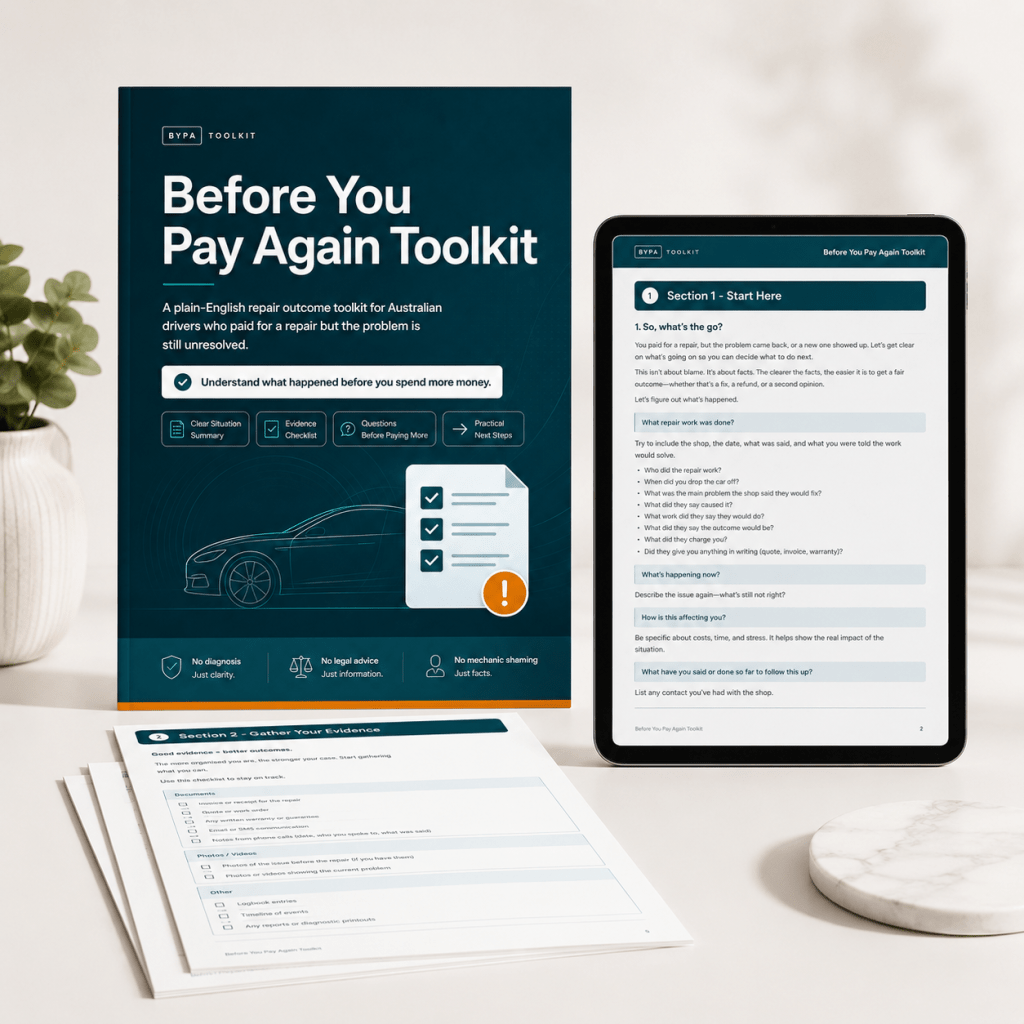
The Before You Pay Again Toolkit is a plain-English PDF worksheet pack that helps you organise exactly that.
It includes a Situation Summary, Repair Outcome Check, Evidence Checklist, Questions Before Paying More, Second Opinion Preparation Sheet, and Before You Decide checklist.
Before you pay again, get your facts clear first.
The Before You Pay Again Toolkit gives you printable worksheets, evidence checklists, second-opinion preparation, and questions to ask before approving more repair work.
