Paid for a car repair and the problem is still there?
Before you approve more work:
Get clear on what you reported, what you approved, what was actually done, and what is still unresolved.
It is frustrating, but before you approve more work, argue with the workshop, get a second opinion, or start escalating the issue, it helps to slow the situation down.
A car can still have a problem after repair for several different reasons.
The original fault may not have been fixed. The first repair may have only dealt with one part of a larger issue. The symptom may have changed. A new fault may have appeared. Or the workshop may not have explained clearly what the first payment actually achieved.
Before paying again, the most useful thing you can do is organise the facts.
This article does not diagnose your vehicle or give legal advice. It gives you a plain-English checklist of what to look at before making the next decision.
What did you originally report?
Start with the first thing you told the workshop.
Write down the exact symptom you reported, not the repair you think it needed.
For example:
• engine light on
• hard starting when cold
• battery going flat overnight
• vibration under braking
• overheating in traffic
• transmission slipping
• air conditioning not cold
• intermittent misfire
• noise from the front end
Try to separate symptoms from assumptions.
Instead of writing:
“The fuel pump was faulty.”
Write:
“The car cranked but would not start after sitting overnight.”
That matters because the workshop can only work from the symptom, the information you gave them, the testing they performed, and the work you approved.
What work did you approve?
Next, look at what you actually approved.
This may be different from what you expected.
Check whether you approved:
• diagnosis only
• scan and report
• replacement of a specific part
• further testing
• repair of one known fault
• repair based on an estimate
• work up to a dollar limit
• work verbally over the phone
• additional parts after the first inspection
This step is important because many disputes start when the customer thinks they approved “fix the car”, but the workshop believes they were approved to perform a specific test, repair, or stage of work.
If the car is still not fixed, the next question is not automatically “who is wrong?”
The next question is:
What was the workshop actually authorised to do?
What does the invoice actually say?
Before paying again, read the invoice carefully.
Look for:
• parts replaced
• labour descriptions
• diagnostic charges
• fault codes recorded
• test results
• recommendations
• notes about further work required
• wording such as “carry out further diagnosis”
• wording such as “customer advised”
• warranty notes
• exclusions or limitations
The invoice may show that the workshop replaced a part, but it may not clearly explain whether the original fault was confirmed, whether testing was completed, or whether the vehicle was expected to be fully repaired.
If the invoice is vague, that does not automatically mean anything improper happened.
But it does mean you need clearer information before approving more work.
What outcome did the workshop say was achieved?
Ask yourself what the workshop actually told you when you picked up the car.
Did they say:
• the car is fixed
• the fault was repaired
• the part was replaced
• the fault could not be duplicated
• more testing is needed
• another issue was found
• drive it and monitor it
• this repair may not fully solve the issue
• come back if the symptom returns
Those are very different outcomes.
If the workshop clearly said more diagnosis may be needed, the situation is different from being told the vehicle was fully repaired.
If they said the vehicle was fixed and the same symptom returned immediately, that is also important to document.
What is still happening now?
Now write down what the vehicle is doing after the repair.
Be specific.
Do not just write:
“Still broken.”
Write things like:
• same symptom as before
• symptom is worse
• symptom is less frequent but still present
• warning light returned after 20 minutes
• car drove normally for two days, then failed again
• noise is still there but only when turning
• car starts now but still stalls
• problem only happens hot
• problem only happens after rain
• new symptom appeared after the repair
The more clearly you describe the current symptom, the easier it is to decide what to ask next.
Is it the same problem, a related problem, or a new problem?
This is one of the most important questions.
Sometimes the same symptom can have more than one cause.
For example, a flat battery could involve:
• an old battery
• alternator output
• a parasitic drain
• poor earth connection
• loose terminal
• aftermarket accessory fault
• module staying awake
A misfire could involve:
• spark plugs
• coils
• injectors
• compression
• wiring
• ECU control
• fuel pressure
• vacuum leak
That does not mean the workshop was automatically right or wrong.
It means you need the repair process explained clearly before you pay again.
What evidence should you collect?
Before approving more work, collect useful information.
Useful evidence may include:
• original booking notes
• estimate or quote
• text messages
• invoice
• receipt
• photos
• videos of the symptom
• dashboard warning lights
• dates and times
• odometer reading
• when the symptom happens
• what changed after the repair
• what the workshop told you verbally
Keep it calm and factual.
Avoid emotional notes like:
“They ripped me off.”
Instead write:
“Vehicle was collected on Monday. Engine light returned Tuesday morning after approximately 18 km. Same rough idle symptom is still present.”
Clear facts are more useful than angry wording.
Questions to ask before approving more work
Before you say yes to another payment, ask questions that clarify the process.
For example:
• What fault did the first repair address?
• Was the original symptom confirmed before the repair?
• What testing was done before the part was replaced?
• What result was expected from the first repair?
• Is the current symptom the same fault, a related fault, or a new issue?
• Why is more diagnosis or repair now being recommended?
• What will the next payment cover?
• What happens if the next repair does not fix the symptom?
• Can you explain the next step in plain English?
You do not need to attack the workshop.
You need to understand what happened.
When a second opinion may help
A second opinion can help when:
• the explanation is unclear
• the invoice does not match what you understood
• the same symptom returned quickly
• more money is being requested but the next step is vague
• you do not understand what the first repair achieved
• the diagnosis process does not make sense to you
• you want another qualified person to inspect the vehicle before approving more work
When getting a second opinion, take your records with you.
Do not just say:
“The last mechanic stuffed it.”
Say:
“This is what I reported. This is what was approved. This is what was replaced. This is what the invoice says. This is what the vehicle is still doing.”
That gives the second workshop better information and reduces confusion.
What not to do straight away
Try not to rush into:
• approving more work without understanding the first outcome
• threatening the workshop before collecting facts
• posting angry reviews while the situation is still unclear
• assuming every returned fault is misconduct
• assuming every repair should guarantee the entire vehicle is fixed
• going to another workshop with no paperwork
• relying only on memory
The better move is to organise the situation first.
Then decide.
A simple before-you-pay-again checklist
Before approving more work, check:
• What did I originally report?
• What did I approve?
• What did I pay for?
• What does the invoice actually say?
• What did the workshop say was achieved?
• What is still happening now?
• Is it the same symptom, a changed symptom, or a new issue?
• What evidence do I have?
• What questions do I need answered?
• Do I need a second opinion before paying more?
Final thought
If you paid for a repair and the car still is not fixed, the next step is not automatically a fight.
The next step is clarity.
Get clear on what was reported, what was approved, what was paid for, what was done, what is still happening, and what needs explaining before you spend more money.
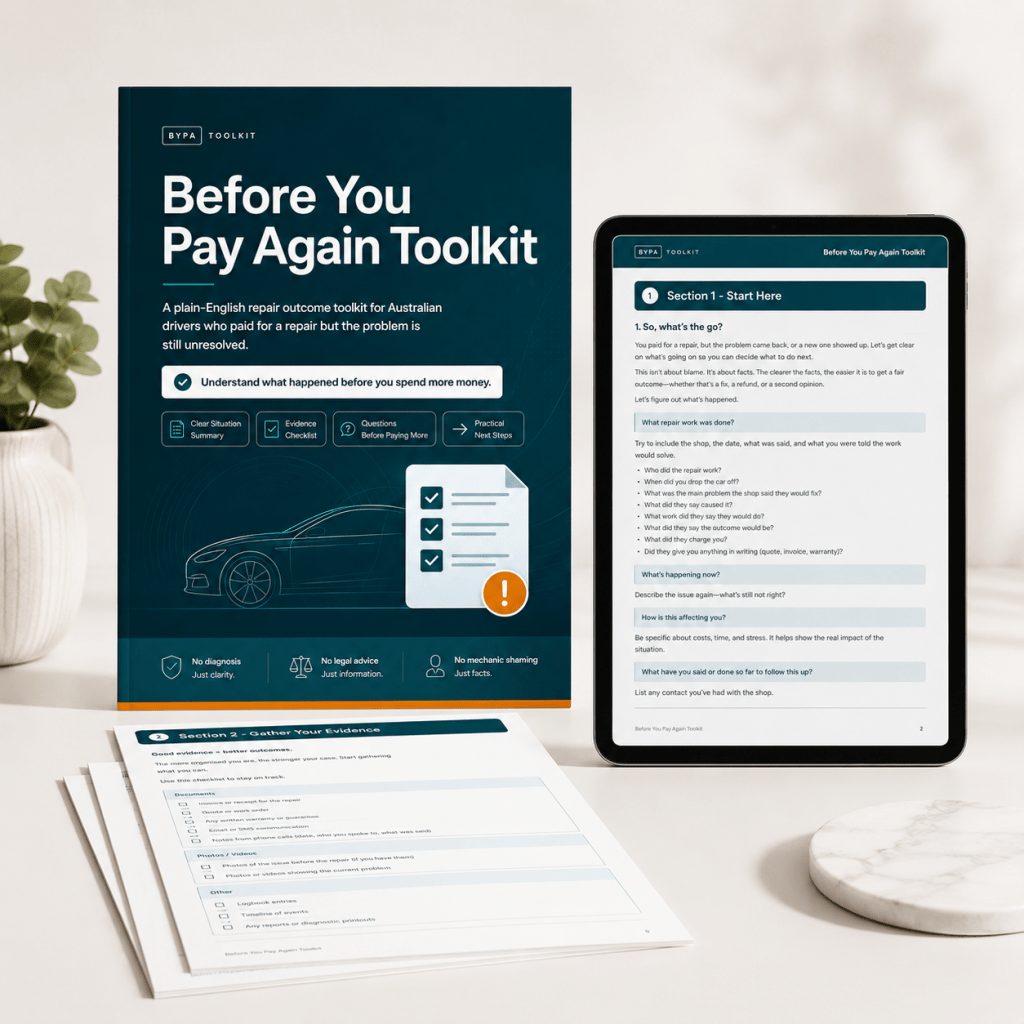
The Before You Pay Again Toolkit is a plain-English PDF worksheet pack that helps you organise exactly that.
It includes a Situation Summary, Repair Outcome Check, Evidence Checklist, Questions Before Paying More, Second Opinion Preparation Sheet, and Before You Decide checklist.
Before you pay again, get your facts clear first.
The Before You Pay Again Toolkit gives you printable worksheets, evidence checklists, second-opinion preparation, and questions to ask before approving more repair work.
