Paid for a repair, but the warning light came back?
That can feel like the repair failed straight away. You paid the mechanic, collected the car, and now the dash light is back on. Maybe it came back on the drive home. Maybe it stayed away for a day or two. Maybe it returned the next time you started the car.
Before you approve more work, slow the situation down.
This article does not diagnose your vehicle. It does not interpret fault codes. It does not give legal advice. It does not tell you whether the workshop was right or wrong.
It gives you a plain-English checklist of what to check before paying more.
Before approving more work:
Get clear on what the warning light originally meant, what was checked, what was repaired, whether the symptom changed, and what the next step is expected to prove.
A warning light coming back does not automatically explain the fault
When a warning light comes back after repair, it is natural to think:
“They didn’t fix it.”
That might be true in some cases.
But a warning light returning does not automatically prove what happened.
It may mean:
- the original issue was not fully resolved
- the fault was intermittent
- the first repair fixed one problem but another remains
- the warning light is now related to a different issue
- the vehicle needs more diagnostic time
- the first repair was a staged repair attempt
- the car was not tested under the same conditions where the problem appears
- the workshop did not clearly explain what the first payment achieved
The useful question is not only:
“Why is the light back on?”
The better question is:
“What did the first diagnosis or repair actually establish, and what is still unresolved?”
Start with the original warning light
Before calling the workshop, write down what originally happened.
Use plain language.
For example:
- “The engine light was on.”
- “The ABS light came on.”
- “The airbag light stayed on.”
- “The battery light came on while driving.”
- “The oil pressure warning appeared.”
- “The temperature warning came up.”
- “The service warning appeared.”
- “A warning message came up on the dash.”
Write down when it happened:
- all the time
- only sometimes
- when starting
- when cold
- when hot
- while driving
- at highway speed
- when braking
- when turning
- after rain
- after a longer drive
- after towing or load
- not sure
This matters because some faults only happen under certain conditions.
Do not recreate a dangerous symptom just to fill this in.
Use what you already noticed.
Look at what the invoice says
Next, look at the invoice or paperwork from the repair.
Copy the key wording exactly.
Look for words such as:
- scan
- fault code
- diagnosis
- inspection
- test
- road test
- cleared codes
- replaced
- repaired
- checked
- no fault found
- further testing required
- customer advised
- warning light reset
Then ask:
Does the invoice explain what was found, or only what was done?
There is a difference.
An invoice might say:
“Scanned and cleared codes.”
That tells you a scanner was used and codes were cleared.
It does not necessarily tell you what caused the warning light, what was tested, what was ruled out, or whether the fault was confirmed.
Another invoice might say:
“Confirmed charging system fault, alternator output low, replaced alternator, road-tested, no battery warning light present.”
That gives a clearer explanation.
If your invoice does not explain the finding, that does not automatically mean the work was wrong. But it may mean you need more clarity before approving more work.
Fault codes are clues, not always final answers
Many warning light repairs involve fault codes.
Fault codes can be useful. But a fault code is not always the same as a confirmed failed part.
A code may point to:
- a sensor reading
- an affected system
- a wiring problem
- a power or ground issue
- a communication fault
- a circuit issue
- an intermittent problem
- a condition caused by another system
- a symptom rather than the root cause
This article will not interpret your fault codes.
The practical questions are:
- What code was found?
- What did the code suggest?
- What did the code not prove?
- Was the code current, stored, pending, intermittent, or historical?
- Was the warning light present during testing?
- Was the code cleared and rechecked?
- Did the same code return?
- Did a different code return?
- Was the part confirmed faulty or only suspected?
The key is to understand what the code actually established.
Ask what was checked before the repair
Before paying more, ask what testing was done before the first repair.
Useful questions include:
- What symptom were you trying to confirm?
- Did the warning light happen while you had the car?
- What tests were performed?
- What fault codes were found?
- What did the codes suggest?
- What did the codes not prove?
- What system was checked?
- What was ruled out?
- What was confirmed?
- What was still uncertain?
Do not ask these questions aggressively.
A useful way to ask is:
“Can you explain what the first diagnosis found, what it ruled out, and what remained uncertain?”
That keeps the conversation focused on the repair process, not blame.
Ask what was repaired or replaced
If a part was replaced or repair work was done, ask why.
Useful questions include:
- What finding led to that part being replaced?
- Was the part confirmed faulty?
- Was it likely faulty?
- Was it suspected?
- Was it part of a staged repair attempt?
- Was the part replaced because of a code?
- Was it replaced because of a test result?
- Was the system checked after the part was fitted?
- Did the warning light return during testing?
- Was the vehicle road-tested after the work?
A replaced part does not automatically prove the part was the whole problem.
Sometimes it is.
Sometimes it is one part of a larger issue.
Sometimes it is a reasonable step based on available evidence, but further testing is still needed.
You need to know how it was presented.
Did the warning light return the same way?
Describe what happened after pickup.
Do not diagnose it.
Write down whether:
- the same warning light came back
- a different warning light came on
- the light returned immediately
- the light returned after a day or two
- the light returned only under certain conditions
- the car drove differently after the repair
- the car improved briefly, then the light returned
- the car is unsafe or undriveable
- you are not sure whether it is the same warning
Useful wording:
“The same warning light appears to have returned.”
or:
“A warning light came back after pickup.”
or:
“The original warning light stayed off, but a different warning appeared.”
Avoid saying:
“The same fault is still there.”
That may or may not be true. The same warning light can sometimes be triggered by more than one cause.
Stick to what you observed.
Ask whether the current warning is the same, related, or new
This is an important distinction.
Ask the workshop:
- Is this the same code as before?
- Is this the same warning light as before?
- Is the current issue related to the original complaint?
- Is it a new finding?
- Could it be connected to the work already performed?
- What changed after the repair?
- Why is more diagnosis or repair now being recommended?
If the answer is unclear, ask for it in writing.
The goal is not to prove someone wrong. The goal is to understand what is happening now.
Do not just keep clearing the light
If the warning light keeps coming back, clearing the code may not be enough.
Ask:
- Was the code only cleared?
- Was the cause tested?
- Did the code return after clearing?
- Was the system rechecked after the repair?
- Is the warning light safety-related?
- Is the vehicle safe to drive?
- What should I record if the light returns again?
Clearing a warning light can be part of the process, but it does not necessarily mean the underlying issue has been resolved.
If the light returns, the next step should be clear.
Ask what the next payment is expected to achieve
If the workshop wants more money, ask what the next step is for.
Ask:
- Is the next charge for diagnosis, testing, labour, parts, towing, storage, or repair?
- What new information will this next step give us?
- What result is it expected to achieve?
- Is it based on a confirmed finding, likely cause, suspected cause, or next test?
- What happens if this next step does not fix the problem?
- Is there a written quote or estimate?
- What is the maximum amount I am approving?
- Will you contact me before exceeding that amount?
- Can parts be replaced without contacting me first?
Do not approve open-ended work if you do not understand what is being proposed.
A clearer approval sounds like:
“I approve up to $___ for diagnosis only. Please contact me before replacing parts or exceeding that amount.”
or:
“I approve the next test only, up to $___, based on your written recommendation.”
That is much clearer than:
“Just keep going.”
Safety comes first
Some warning lights are more urgent than others.
This article does not tell you whether your car is safe.
If the warning light may relate to brakes, steering, airbags, oil pressure, overheating, charging, electrical smoke, severe drivability problems, or anything that makes the vehicle feel unsafe, ask whether the vehicle should be driven.
Ask:
- Is the vehicle safe to drive as it is?
- Should it be towed?
- Should I stop driving it until it is inspected?
- Is the warning safety-related?
- What should I do if the warning appears again?
Do not drive the vehicle just to test whether the warning light comes back.
Use what you already observed.
When a second opinion may help
A second opinion may be useful if:
- the warning light came back and the explanation is unclear
- the workshop wants more money but has not explained what the next step will prove
- multiple parts are now being suggested
- the vehicle may be unsafe
- you do not understand what the first diagnosis found
- you want another qualified person to assess the current warning
A second opinion is not automatically proof the first workshop was wrong.
It is another qualified assessment.
Take copies of:
- the invoice
- diagnostic notes
- fault-code printout, if supplied
- list of parts replaced
- messages from the workshop
- photos of the warning light
- written recommendation for more work
- your plain-English summary of what happened
Do not hide the previous work from the second repairer. They need to know what has already been done.
A simple message you can send
You could send:
Hi, I am trying to understand the next step before I approve more work.
The warning light has come back after the repair.
Can you please explain what the first diagnosis found, what was ruled out, and whether the current warning is the same code, a related issue, or a new finding?
Can you also explain what the next recommended step is expected to clarify, and what the estimated cost will be?
If possible, please put the recommendation and cost estimate in writing before I approve anything further.
Thanks.
What not to assume
Try not to assume:
- the warning light coming back automatically proves the repair was wrong
- the same warning light always means the same fault
- a fault code automatically proves a part has failed
- clearing the code means the problem is fixed
- a new warning light is definitely caused by the previous repair
- a second opinion automatically proves the first workshop was wrong
- paying for a repair always means the whole issue was guaranteed fixed
Some of those things may become clearer later.
But first, organise the facts.
Final thought
If a warning light came back after repair, the next step is not automatically blame.
The next step is clarity.
Before approving more work, get clear on:
- what warning light originally appeared
- what fault codes were found
- what the codes did and did not prove
- what tests were performed
- what was repaired or replaced
- whether the warning was checked after the work
- whether the same warning returned
- whether the current issue is the same, related, or new
- what the next payment is expected to achieve
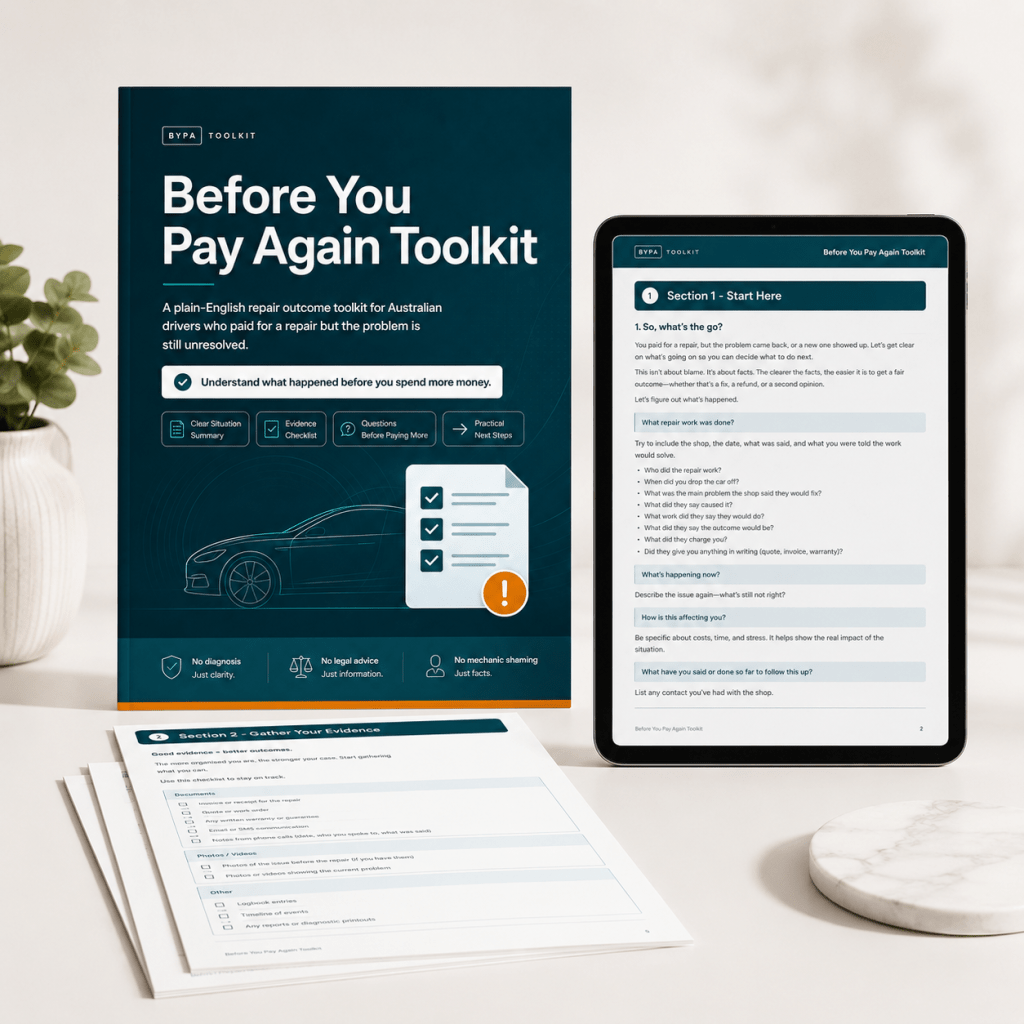
The Before You Pay Again Toolkit is a plain-English PDF worksheet pack that helps you organise exactly that.
It includes a Situation Summary, Repair Outcome Check, Evidence Checklist, Questions Before Paying More, Second Opinion Preparation Sheet, and Before You Decide checklist.
Before you pay again, get your facts clear first.
The Before You Pay Again Toolkit gives you printable worksheets, evidence checklists, second-opinion preparation, and questions to ask before approving more repair work.
